Journal · Buying guide
Hair Extensions for Curly and Wavy Indian Hair
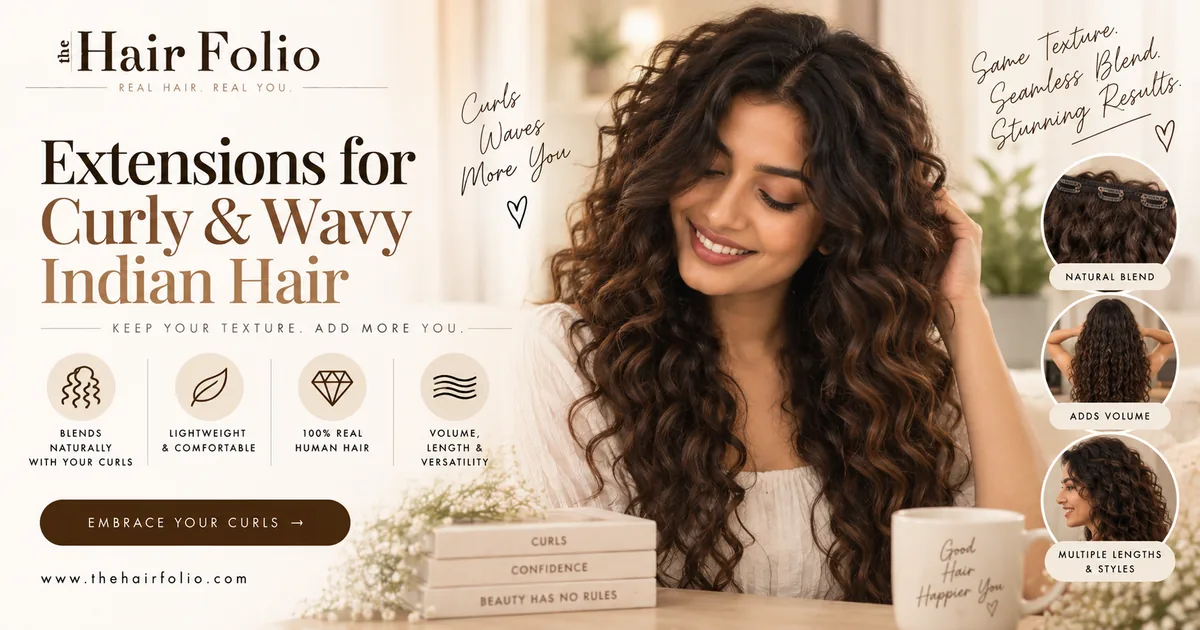
Short answer: For curly or wavy hair, matching the curl pattern matters more than matching the shade. Account for shrinkage — curly hair hangs considerably shorter than its measured straight length, so order longer than the length you want to see. Ask whether the curl is natural to the donor hair or steam-processed in, because steam-set curls relax over time and eventually stop holding.
Key takeaways
- Match pattern first, colour second. Wrong texture ruins a perfect shade.
- Curly hair shrinks by roughly a third. Order by visible length, not label length.
- Steam-set curls relax. Naturally curly donor hair holds its pattern.
- Curly texture reads darker than the same shade in straight hair.
- Curly extensions need more moisture and far less brushing.
Why is extension advice usually wrong for curly hair?
Because almost all of it is written for straight hair, where length is length and the only real variable is shade.
Curly and wavy hair changes three things at once: how long the hair looks versus how long it measures, how the colour reads, and how the two textures sit together at the join. Get the shade perfect and the pattern wrong and the result still looks like a wig.
Indian hair spans an unusually wide range — poker straight, soft S-wave, tight coil, and everything between, often on the same head. That makes matching harder here than in markets with narrower texture ranges.
How much does curly hair shrink?
Enough to change what you order.
Hair is measured stretched. Curly hair does not hang stretched. The difference is shrinkage, and it scales with how tight the pattern is.
| Pattern | Rough shrinkage | 20″ measured hangs at about |
|---|---|---|
| Loose wave | 10–15% | 17–18″ |
| Defined wave / loose curl | 20–30% | 14–16″ |
| Tight curl | 30–40% | 12–14″ |
| Coil | 40%+ | 12″ or less |
So a 20-inch curly extension can sit at 13 inches visually. Someone expecting waist-length gets mid-back and feels misled, even though nothing was mislabelled.
Order by the length you want to see, then add back the shrinkage. Want 16 inches of visible curly length at a 30% pattern? Order around 22 to 24 inches.
This also matters for matching: your own curly hair is shrinking by the same proportion, so compare stretched-to-stretched or hanging-to-hanging, never one against the other.
Is the curl natural or processed in?
This is the question that separates extensions that last from extensions that disappoint in month four, and almost nobody asks it.
Much of the curly extension hair on the market is steam-processed. Straighter donor hair is set into a curl pattern using heat and steam. It looks convincing when new.
Over time, and faster with washing, that curl relaxes. The hair gradually reverts toward its native pattern. You end up with wavy hair where you bought curly, and no amount of product brings the original pattern back — it was never the hair’s own pattern.
Naturally curly donor hair holds its curl for the life of the hair, because the pattern is structural. It comes from the shape of the follicle it grew out of, not from a treatment.
Ask directly: is this curl natural to the donor, or steam-set? A seller who controls their supply answers immediately. The answer also explains a price gap — naturally curly single-donor hair is harder to source and costs more, for a reason you can feel a year later.
This sits alongside the alignment question in Remy vs virgin hair. Both are supply-chain questions that determine how the hair behaves long after purchase.
How do I match the pattern?
Compare your hair and the extension in the same state — both freshly washed and air-dried with no product, or both with your usual product routine. Comparing your styled hair to a dry extension tells you nothing.
What to look at, in order:
- Curl diameter. Wrap a strand around a finger. How many turns before it repeats? That is the quickest comparison.
- Consistency. Most natural hair is not uniform — looser at the crown, tighter at the nape. Extension hair is usually uniform. Place the closest-matching pieces where your hair is most similar.
- Volume at the root. Curly extensions are often curly to the weft, while your own hair may be looser at the root. If so, the extension can sit fuller than your hair at the top, which shows.
If your own pattern varies a lot across your head, a slightly looser extension usually blends better than a tighter one. Loose hair can be encouraged tighter with product; tight hair cannot easily be loosened without heat, and heat on curly extensions is a one-way door.
Which attachment type suits curly hair?
| Type | Fit for curly hair | Why |
|---|---|---|
| Clip-in | Good | Easy to reposition; comes out nightly, which curly hair benefits from |
| Sew-in weft | Very good | Traditional for textured hair; secure and no adhesive |
| Tape-in | Fair | Adhesive and heavy conditioner conflict, and curly routines are conditioner-heavy |
| Micro-ring | Good | No adhesive, so your moisture routine is unaffected |
| Halo | Fair | Needs enough hair over the wire; volume can push it up |
| Keratin bond | Fair | Bonds dislike the oils and butters curly hair needs |
The recurring theme: adhesive and curly hair routines fight each other. Curly hair needs conditioner, oil and leave-in product. Those are exactly what break down tape and keratin bonds. If you follow a proper curly routine, sew-in wefts, micro-rings or clip-ins are the more compatible choices.
How does texture change the colour match?
Straight hair reflects light in a continuous sheet and reads lighter and shinier. Curly hair scatters light across many angles and reads darker and more matte.
So the same shade number looks different in the two textures. Match a curly extension to your straight-hair swatch and it will look a shade or two darker on your head.
Practical rule: when matching curly extensions, judge them in the curl, never stretched out straight. And if your own hair is curly but the extension is straight, expect the extension to read lighter even at an identical shade.
Our colour matching guide covers the undertone problem, which stacks on top of this.
How do I care for curly extensions?
Curly extensions need more moisture and far less mechanical handling than straight ones. They also have a hard limit your own hair does not: no scalp.
Your curls get sebum from your scalp. Extensions get nothing. Everything moisturising has to come from you, every time.
- Detangle wet, with conditioner in, using fingers or a wide-tooth comb. Never brush curly extensions dry. Brushing dry curls separates the curl clumps into frizz and the pattern does not come back until the next wash.
- Wash less often. Every 15 to 20 wears is plenty. Sulphate-free only.
- Condition the lengths generously, and keep conditioner off the wefts — it loosens knots and causes shedding at the top.
- Air-dry, or diffuse on low. High heat relaxes curl pattern permanently in extension hair.
- Store stretched or loosely coiled, not crushed into a drawer. Crushed curls set into odd shapes.
- Refresh between washes with a water and leave-in mist rather than rewashing.
The general routine in how to wash hair extensions applies, with more conditioner and less brushing.
Can I straighten curly extensions?
Human hair extensions can be straightened, but think twice.
Each heat pass relaxes the curl pattern slightly, and extension hair has no way to recover — it gets no sebum, no new growth, no repair. Straighten a curly set repeatedly and within months it will not return to its original pattern.
If you want both looks regularly, two sets is the honest answer: one curly, one straight. It costs more upfront and both last far longer than one set heat-cycled back and forth.
If the curl was steam-set rather than natural, heat accelerates the relaxing that was going to happen anyway.
FAQ
How do I know what length curly extensions to order?
Work out the visible length you want, then add back shrinkage — roughly 20–30% for a defined curl, more for tighter patterns. For 16 inches of visible length at a 30% pattern, order around 22–24 inches.
Why did my curly extensions go straight after a few months?
The curl was almost certainly steam-processed rather than natural to the donor hair. Steam-set patterns relax with washing and time as the hair reverts toward its own texture. Naturally curly donor hair keeps its pattern structurally.
Can I use my regular curly hair products on extensions?
Yes for the lengths — leave-ins, creams and gels are fine and necessary, since extensions get no sebum. Keep heavy product off the wefts or bonds, because oil loosens knots and breaks down tape and keratin adhesive.
Do I need to match my curl pattern exactly?
Close is enough, and slightly looser is safer than slightly tighter. Looser hair can be encouraged into a tighter pattern with product, but loosening a tight pattern needs heat, which permanently relaxes extension hair.
Which extension type is best for curly hair?
Sew-in wefts, micro-rings or clip-ins. All three avoid adhesive, which matters because the conditioners and oils a curly routine requires are exactly what breaks down tape and keratin bonds.
Why do my curly extensions look darker than my hair?
Curly texture scatters light rather than reflecting it in a sheet, so the same shade reads darker and more matte. Always compare in the curl rather than stretched straight.
How often should I wash curly extensions?
Every 15 to 20 wears, with sulphate-free shampoo. Between washes, refresh with a water and leave-in mist rather than rewashing — every wash costs you a little curl definition.
About the author
The Hair Folio is an Indian hair extensions label selling 100% human Remy hair — extensions, toppers, wigs and accessories, shade-matched for Indian hair and shipped across India.
Every bundle we sell is single-donor and cuticle-aligned root to tip, hand-tied into flat-seam wefts, and shade-checked in daylight before it is boxed. We started writing these guides because the Indian market is full of unregulated terms — Remy, virgin, raw, blend — and customers were paying human-hair prices for coated, acid-stripped hair that looked excellent for a month.
What we work with daily: single-donor Remy sourcing · cuticle alignment and weft construction · toning and checking shades against Indian hair in daylight · clip-in, tape-in, halo and ponytail fitting · toppers and volumizers for thinning hair · men’s hair patches · wigs including medical and chemo use · extension care, washing and storage.
Find us: Instagram · WhatsApp · About The Hair Folio · Contact · FAQs
These guides are reviewed as our own stock and the market change. If a price, timeline or claim here looks wrong when you read it, tell us and we will check it and correct it within 48 hours.