
Journal · Buying guide
Human Hair vs Synthetic Extensions: Which Should You Actually Buy?
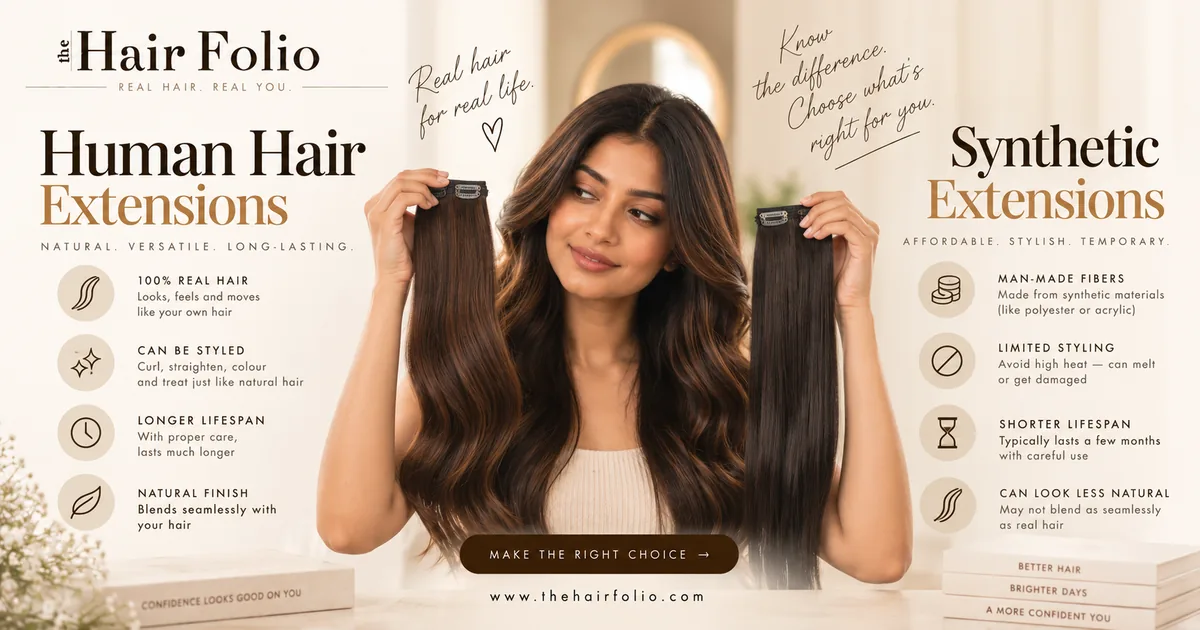
Short answer: Human hair extensions can be heat-styled, coloured and worn daily for months to years, and they move and reflect light like your own hair. Synthetic extensions are plastic fibre — they hold a heat-set style permanently, which is useful in humidity, but cannot take heat tools, cannot be dyed, and last a fraction as long. For anything you plan to wear regularly, human hair wins on cost per wear despite the higher sticker price.
Key takeaways
- Synthetic holds a fixed style; human hair takes any style.
- Synthetic cannot be heat-styled beyond its rating or dyed at all.
- Lifespan: synthetic roughly 1–3 months of regular wear; human hair 6 months to 2 years.
- Cost per wear usually favours human hair by a wide margin.
- Synthetic genuinely wins for one-off bold colours and humidity-proof curls.
What is the actual difference?
Human hair extensions are hair. They have a cuticle, a cortex, and they behave exactly like the hair growing out of your head — because that is what they are.
Synthetic extensions are fine plastic filament, usually modacrylic or a polyester blend, extruded to roughly the diameter of a hair and treated to mimic its surface. Good synthetic is impressively convincing in a photograph. In daylight, it reflects light more uniformly than hair does, which reads as a slight sheen that hair does not have.
The difference that drives everything else is what happens under heat. Hair is keratin, held together by disulphide bonds, which is why a curling iron can temporarily rearrange it. Plastic has a melting point. Apply a straightener to standard synthetic and you do not straighten it — you melt it, permanently, in one pass.
How do they compare across what matters?
| Human hair | Synthetic | |
|---|---|---|
| Heat styling | Yes, like your own hair | No, unless heat-friendly grade |
| Colouring | Yes (darkening safer than lifting) | No |
| Lifespan, regular wear | 6 months – 2 years | 1–3 months |
| Holds a set style | No, needs restyling | Yes, permanently |
| Behaviour in humidity | Frizzes like real hair | Holds its curl |
| Look in daylight | Natural | Slight uniform sheen |
| Movement | Natural | Stiffer, lighter |
| Washing | Like hair, gets softer | Degrades with each wash |
| Upfront cost | Higher | Lower |
| Cost per wear | Usually lower | Usually higher |
Why does synthetic hold a curl so well?
Because the curl is not styled in. It is set into the fibre at manufacture using heat, and plastic holds the shape it cooled into.
Wash a synthetic curly set, let it dry, and the curls come back exactly as they were. No product, no iron, no effort.
Human hair cannot do that. A curl in human hair is temporary by definition. In a Mumbai or Chennai monsoon, human hair absorbs moisture from the air and the curl drops within hours, the same way your own hair does.
So for a fixed curly or wavy style in high humidity, synthetic genuinely outperforms human hair. That is not a consolation prize — it is a real engineering advantage, and it is the main reason to choose synthetic deliberately rather than by budget.
The flip side is that you cannot change it. A synthetic curly set is curly forever. You cannot straighten it for a different look.
What about heat-friendly synthetic?
Mid-range synthetic now comes in heat-resistant grades, usually rated to somewhere around 160–180°C. They can be gently restyled.
Two honest caveats. The rating is a ceiling, not a target — most straighteners run far hotter by default and will destroy the fibre at their usual setting. And each heat cycle degrades the fibre, so “heat-friendly” means a limited number of restyles, not unlimited.
Treat it as a useful feature, not as equivalence with human hair.
Which lasts longer, and what does that do to the price?
This is where the obvious answer reverses.
A synthetic set worn regularly gives roughly 1 to 3 months. Friction at the nape causes irreversible tangling, because you cannot condition plastic back to smoothness the way you can condition hair.
A good Remy human hair set gives 6 months to 2 years depending on type and care. Our lifespan guide breaks this down by attachment method.
Run the cost-per-wear maths:
- Synthetic set, ₹2,000, 40 wears → ₹50 per wear
- Human hair set, ₹12,000, 400 wears → ₹30 per wear
The human set costs six times more and works out cheaper per wear. And that ignores the hours spent detangling a synthetic set in its final weeks.
The reversal only holds if you actually wear them regularly. For one event a year, synthetic is the correct economic answer.
Does synthetic damage my hair more?
Not directly — neither material is inherently harmful. But synthetic creates a secondary risk.
Synthetic tangles far more readily, and tangled hair gets pulled. Every detangling session on a matted synthetic set applies tension to the anchor points. Over a few months that is real traction on your own hair.
Non-Remy human hair has the same problem for the same reason, which is covered in Remy vs virgin hair. The common factor is tangling, not the material.
The safety mechanics themselves are in do hair extensions damage your hair.
What is a “human hair blend”?
Mostly synthetic with some human hair, sold at close to human-hair prices. There is no minimum percentage required to use the phrase in India.
Blends fail in a specific and visible way: the two fibre types respond differently to humidity and heat. On a humid day, the human strands swell and frizz while the synthetic strands stay flat. Half the bundle goes one way, half the other.
If a listing says blend, price it as synthetic.
To check what you actually have, burn five strands from a hidden spot. Human hair ashes and smells of burnt hair. Synthetic melts into a hard bead and smells of plastic. A blend does both. Full method in Remy vs virgin hair.
So which should I buy?
Buy human hair if you will wear them more than a few times a month, want to straighten or curl them, want to match a colour precisely, want them to last past one season, or have fine hair where weight and natural movement matter.
Buy synthetic if you want a bold colour for one event, want a curl pattern that survives humidity with no effort, are testing whether extensions suit you at all, or genuinely need the lowest upfront number.
Most people asking the question want daily or weekly wear, and for that human hair is the right answer on both appearance and cost per wear.
If budget is the constraint, buy less human hair rather than more synthetic. A smaller set of good Remy hair, placed well, beats a full head of synthetic — and it lasts. Our price guide shows where the real floors sit.
FAQ
Can you tell the difference between human and synthetic extensions?
In a photograph, often not. In daylight and in motion, usually yes — synthetic reflects light more uniformly, giving a slight sheen, and it moves more stiffly because the fibre is lighter and less flexible than hair.
Can synthetic hair extensions be straightened?
Standard synthetic cannot — heat melts the fibre permanently in one pass. Heat-friendly grades tolerate roughly 160–180°C, which is below the default setting on most straighteners, and each heat cycle degrades them further.
How long do synthetic extensions last?
One to three months with regular wear. They fail by tangling, and because you cannot condition plastic smooth again, the tangling is irreversible once it starts.
Is synthetic hair bad for your hair?
Not directly, but it tangles more, and detangling applies tension to your anchor points. Over months that is a genuine traction risk. The material is not the problem; the pulling is.
Why is human hair so much more expensive?
It is collected, sorted and kept cuticle-aligned by hand, which is slow manual work, and supply is finite. Synthetic is extruded by machine at scale. The price gap reflects labour and scarcity rather than branding.
What does “human hair blend” mean?
Mostly synthetic with some human hair mixed in, at no regulated minimum. Blends behave inconsistently in humidity because the two fibres react differently. Price them as synthetic.
Is synthetic better for curly styles?
For holding a fixed curl through humidity, yes — the curl is heat-set into the fibre and returns after every wash with no effort. The trade-off is that you can never change it. For curly Indian hair specifically, see extensions for curly and wavy hair.
About the author
The Hair Folio is an Indian hair extensions label selling 100% human Remy hair — extensions, toppers, wigs and accessories, shade-matched for Indian hair and shipped across India.
Every bundle we sell is single-donor and cuticle-aligned root to tip, hand-tied into flat-seam wefts, and shade-checked in daylight before it is boxed. We started writing these guides because the Indian market is full of unregulated terms — Remy, virgin, raw, blend — and customers were paying human-hair prices for coated, acid-stripped hair that looked excellent for a month.
What we work with daily: single-donor Remy sourcing · cuticle alignment and weft construction · toning and checking shades against Indian hair in daylight · clip-in, tape-in, halo and ponytail fitting · toppers and volumizers for thinning hair · men’s hair patches · wigs including medical and chemo use · extension care, washing and storage.
Find us: Instagram · WhatsApp · About The Hair Folio · Contact · FAQs
These guides are reviewed as our own stock and the market change. If a price, timeline or claim here looks wrong when you read it, tell us and we will check it and correct it within 48 hours.
