Journal · Buying guide
Best Hair Extensions for Short Hair: What Actually Blends
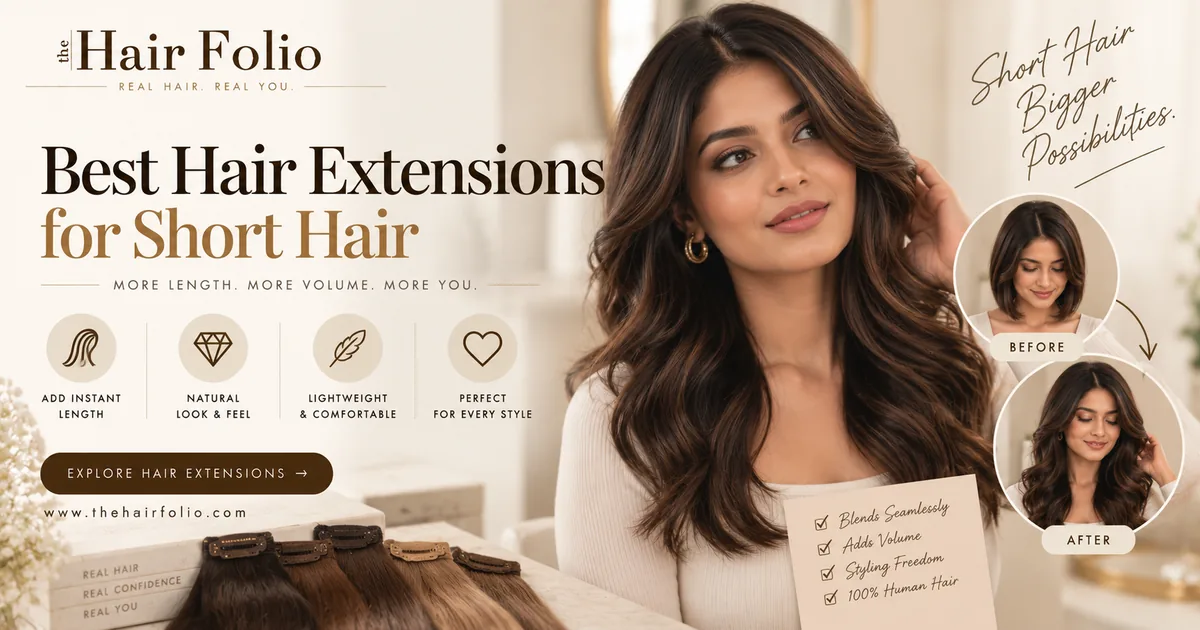
Short answer: You can wear extensions with short hair from roughly 4 inches, which is enough to conceal a clip or tape tab. The difficulty is not attaching them, it is blending them — short hair ends abruptly while the extension continues, creating a visible shelf. The fix is layering the extension into your own length and limiting how much length you add at once. Roughly twice your current length is the realistic ceiling.
Key takeaways
- 4 inches is about the minimum to hide an attachment.
- The problem is blending, not attaching.
- Add no more than about 2× your own length in one step.
- Layering the extension is what removes the shelf. Non-negotiable for short hair.
- More, narrower wefts placed at staggered heights beat a few wide ones.
Can I wear extensions with short hair?
Yes, from about 4 inches of hair — roughly a chin-length bob or longer. Below that there is not enough length to cover a clip base or tape tab, and the attachment itself becomes visible when you move.
If your hair is shorter than 4 inches, your realistic options are a topper for volume at the crown, or a wig. Clip-ins will not sit invisibly.
Between 4 and 8 inches, extensions work but need deliberate cutting. Above 8 inches the problem largely solves itself.
Why is blending so much harder with short hair?
Because of how the two lengths meet.
With long hair, your own hair and the extension overlap for most of their length. The transition is gradual and your eye never finds an edge.
With short hair, your own hair ends at one defined point. Below that line, the only hair present is extension hair. Above it, both. Your eye reads the density change as a horizontal shelf — and because short cuts are usually blunter, the line is sharper still.
You are not hiding an attachment. You are hiding a density step.
Two things fix it, and they work together.
How do I actually fix the shelf?
Layer the extension
This is the one that matters, and it is the step people skip because cutting something you just paid for feels wrong.
A stylist cuts soft, long layers into the top portion of the weft. Instead of every strand in the weft being the same length, the strands now end at different points. Your own hair’s end is no longer meeting a solid wall of extension — it is meeting a gradient.
Done properly this is invisible. Done not at all, no amount of styling hides it.
Take the extensions to the stylist who cuts your hair, clipped in, and have them cut in place on your head. Cutting them flat on a table does not account for how they sit.
Limit the jump
Going from a chin-length bob to waist-length in one purchase does not blend. There is too much length carrying no support from your own hair, and it hangs separately.
Roughly twice your own length is the ceiling for a convincing result. A 6-inch bob blends well to about 12 inches. Pushing to 20 will look like what it is.
If you want a dramatic change, do it in two stages as your own hair grows, or accept that the look is “wearing extensions” rather than “long hair”.
Which type works best for short hair?
| Type | Works on short hair? | Notes |
|---|---|---|
| Clip-in (narrow wefts) | Best | Most control over placement. Use several narrow wefts, not wide ones. |
| Tape-in | Good | Thin, flat tabs sit well under short layers. Needs a stylist. |
| Halo | Poor | The wire needs enough hair over it to hide. Short hair rarely covers it. |
| Ponytail / wrap | Situational | Only if you can gather your hair into a ponytail at all. |
| Micro-ring | Good | Small attachment points, easy to place. Salon-fitted. |
| Weft (sew-in) | Fair | Needs enough hair to braid a track into. |
Narrow clip-in wefts are the usual answer. A standard set often comes with a couple of wide wefts designed for the back of a long head of hair, and those are the hardest pieces to place on short hair. More, narrower pieces placed at staggered heights give you the gradient you need.
Our clip-in vs tape-in vs halo comparison covers the broader trade-offs.
Where should the wefts go?
The instinct is to put everything low, near the nape, to maximise length. That is exactly what creates the shelf — all the extension hair starting at the same height.
Instead, stagger the heights:
- A couple of narrow wefts low at the nape for base length.
- A couple at mid-head height.
- One or two small pieces higher, at the sides, to carry the gradient upward.
The higher pieces are what make it read as a gradual change in density rather than a sudden one. They also need the most layering, since they sit closest to where your own hair ends.
Keep the top 2 to 3 inches below your parting free of wefts, so your own hair covers everything from above.
What about volume rather than length?
If what you actually want is thicker short hair rather than longer hair, the problem is much easier.
Short wefts cut to your existing length, placed at the sides and crown, add density without creating any length transition at all. There is no shelf because there is no new length.
This is a genuinely underused option. A bob with added density reads as expensive hair. A bob with 14 inches hanging off it reads as extensions.
For fine hair in particular, weight distribution matters — see extensions for thin hair.
Does the texture need to match?
More than at longer lengths, yes.
At 20 inches, a slight texture difference disappears in the overall movement. At 10 inches, with the join sitting right in the visible zone, a straight extension against wavy hair is obvious.
Either match the texture or commit to styling both together every time you wear them. Styling both is the more common solution — a light wave through your own hair and the extensions, done at once, hides a lot. Extensions for curly and wavy hair goes into texture matching.
Will a short bob work, honestly?
A chin-length bob at 5 to 6 inches works with layered extensions up to about 12 inches, and looks good.
A very short bob at 3 to 4 inches is borderline. Clips become hard to hide, especially when you tuck hair behind your ears.
A pixie cut does not work with clip-ins. There is nothing to clip into and nothing to hide the base with. A topper or wig is the honest answer there.
FAQ
What is the minimum hair length for clip-in extensions?
About 4 inches — roughly a chin-length bob. Below that there is not enough hair to cover the clip base, and the attachment shows when you move or tuck hair behind your ears.
Why do my extensions look obvious with short hair?
Almost always the shelf: your own hair ends at one defined point and the extension continues below it, creating a visible density step. The fix is having a stylist cut soft layers into the extension so the lengths overlap gradually.
How long can I go from a bob?
Roughly twice your own length for a convincing blend. A 6-inch bob blends well to about 12 inches. Going much beyond that leaves length hanging with no support from your own hair.
Should I cut my extensions?
Yes, and for short hair it is essential rather than optional. Have them cut in place, clipped into your hair, by the stylist who cuts your hair. Cutting them flat on a table does not account for how they actually sit.
Can I wear a halo with short hair?
Usually not well. The halo wire sits across the top of your head and needs enough of your own hair pulled over it to disappear. Short hair rarely provides that coverage.
Can I get extensions with a pixie cut?
Not clip-ins — there is nothing to clip into and nothing to conceal the base. A topper for crown volume or a wig for full length are the realistic options.
Is it better to add volume or length to short hair?
If you are unsure, volume. Short wefts cut to your existing length add density with no transition to hide, so there is nothing to give them away. Length is the harder effect to pull off well.
About the author
The Hair Folio is an Indian hair extensions label selling 100% human Remy hair — extensions, toppers, wigs and accessories, shade-matched for Indian hair and shipped across India.
Every bundle we sell is single-donor and cuticle-aligned root to tip, hand-tied into flat-seam wefts, and shade-checked in daylight before it is boxed. We started writing these guides because the Indian market is full of unregulated terms — Remy, virgin, raw, blend — and customers were paying human-hair prices for coated, acid-stripped hair that looked excellent for a month.
What we work with daily: single-donor Remy sourcing · cuticle alignment and weft construction · toning and checking shades against Indian hair in daylight · clip-in, tape-in, halo and ponytail fitting · toppers and volumizers for thinning hair · men’s hair patches · wigs including medical and chemo use · extension care, washing and storage.
Find us: Instagram · WhatsApp · About The Hair Folio · Contact · FAQs
These guides are reviewed as our own stock and the market change. If a price, timeline or claim here looks wrong when you read it, tell us and we will check it and correct it within 48 hours.